By Vicky Mejia
Goodman Resident director Chuck Smith revisits August Wilson’s Ma Rainey’s Black Bottom for the first time at The Goodman since 1997 with music director Harry Lennix (Inherit the Wind) who also graced The Goodman stage as LEVEE during the original run of the show. And while Smith and Lennix return to breath new life and new discoveries into the work, they aren’t the only artists returning to The Goodman to take on this grand revival. We spoke with Kelvin Roston Jr. (Gem of the Ocean, Crowns) who plays TOLEDO to discuss what makes being a part of this revival—and the Goodman family—so special.
Goodman Theatre: Tell us about your previous work at The Goodman.
Kelvin Roston Jr.: My first experience on a Goodman stage was in 2010 with Congo Square Theatre Company’s production of The Nativity, adapted by McKinley Johnson and directed by Aaron Todd Douglas. This production featured Congo Square Ensemble member, Alexis J Rogers, now Alexis J Roston, my wife. I’m now an ensemble member of Congo Square, but then, I had only been in Chicago for two years. So this was huge for me.
My second time at The Goodman was in its production of Crowns written and directed by Regina Taylor. This cast also included my wife. Other cast members included E Faye Butler, Felicia P Fields, Shari Addison, and Pauletta Washington. I got to meet Denzel Washington when he came to see the show (and his wife).
The third and last time was as CEASAR in August Wilson’s Gem of the Ocean directed by Chuck Smith. That was my first time working with Chuck. I’m so honored to, now, be working with Chuck again, along with Harry Lennix (again) in this production of August Wilson’s Ma Rainey’s Black Bottom as Toledo. I’ve done six of the shows in August Wilson’s Century Cycle, but this show is the only one I’ve done multiple times. The first as SLYVESTER (Court), second as LEVEE (Writers), and now TOLEDO at Goodman. I love that I actually get to play the piano live. This one is special.
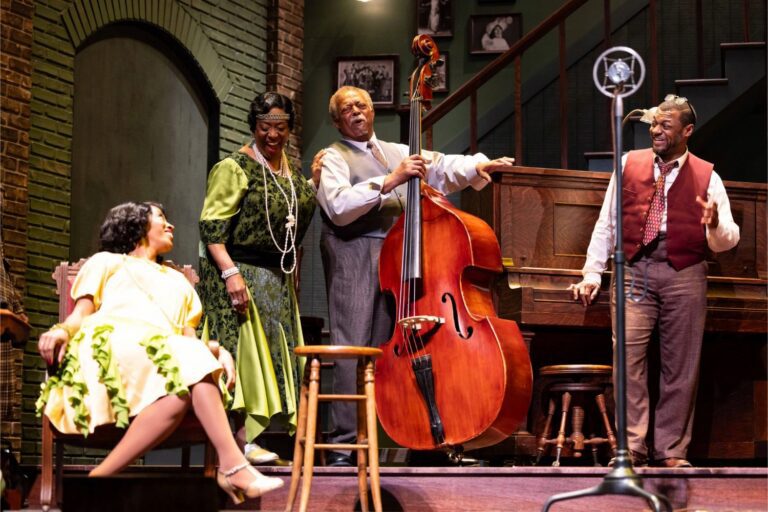
(L-R) Tiffany Renee Johnson, E. Faye Butler, Cedric Young, Kelvin Roston Jr. Photo by Justin Barbin.
GT: What is it like to work with director Chuck Smith for the second time?
KRJ: Working with Chuck again is amazing. We speak each other’s language, sometimes that is. I have to catch up at times. He’s a true living legend. And being able to be a part of his [upcoming] documentary, priceless.
GT: You have been a part of impactful productions that center the Black experience. What are your thoughts on the current state of Black storytelling in theater?
KRJ: There are many theaters attempting to tackle August Wilson’s work. I love that. That, alone, gives a strong and visceral representation of the Black experience. However, with August Wilson being the American Shakespeare, there is an elevated level of accomplishment for those theaters who can produce his shows successfully. Goodman is in a different category, of course, being the 1st to produce all 10 shows in the Cycle, working with August as he wrote them. Also, I’ve experienced Goodman attempting to make shows about the Black experience, and people of color in general, a regular part of their seasons, and not exclusively in February. It seems to me, however, that many others are still caught up in the antiquated habit of only using February to touch on the experience of “others”. What I noticed this season is that when the person in the White House cut the DEI money, which many of these theaters were receiving for doing Black and POC shows, and the opportunity presented itself to put THEIR money where their mouths were, most decided that it was no longer necessary. I thank and applaud Goodman for NOT being one of them.
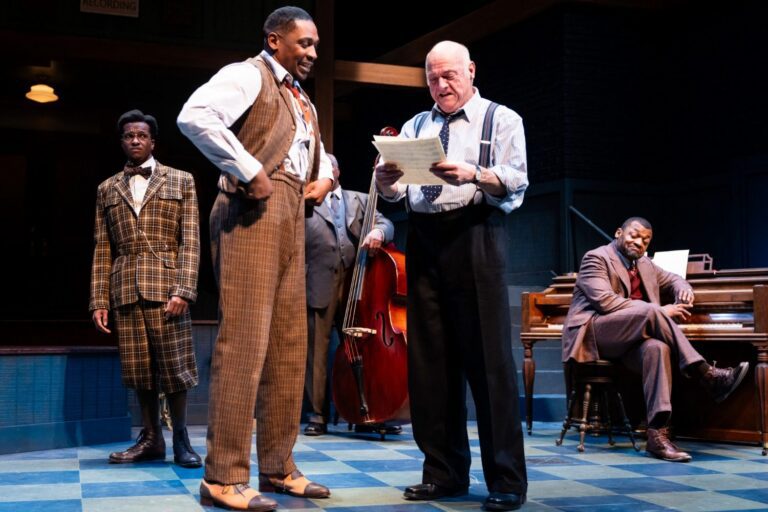
(L-R) Jabari Khaliq, Al’Jaleel McGhee, Cedric Young, Matt DeCaro, Kelvin Roston Jr. Photo by Justin Barbin.
GT: As you mentioned, you play TOLEDO in this production of Ma Rainey. What parts of your character do you relate to?
KRJ: August Wilson was exceptional at capturing the essence of Black people. ALL of his characters, in my opinion, are archetypes of individuals in my family and life. I’ve met a version of every character August created. In Ma Rainey’s Black Bottom specifically, playing TOLEDO is an honor on so many levels. First of all, yes, there are quite a few parts of him that I relate to. Like TOLEDO, I’m a pianist. I like to consider myself somewhat of an intellectual. Like him, I can, sometimes, seem like a know-it-all. I’m also passionate about my people and want us to all do better, be better. I really believe TOLEDO desires that of his friends. I have some CUTLER/LEVEE hot-head tendencies. I’m doing better at knowing my worth, and what I have to offer, like MA. There are just so many things I can name.
GT: August Wilson always brings out revelatory truths and lessons in his plays. What is something that you hope audiences take with them after experiencing this production?
KRJ: We could easily stereotype all of these characters. I challenge the audience not to do that. I challenge them to look at the individual, in each of their different stations in life, with varying experience coping in the environment of the time, and truly try to understand what’s shaped them. I challenge them to attempt to see themselves in some of the characters’ choices. There’s examples of misplaced anger, belittling, lying, using, lust, etc; all human behaviors. I’d like them to leave wanting to be better humans, wanting to be better to OTHER humans, in spite of any differences.
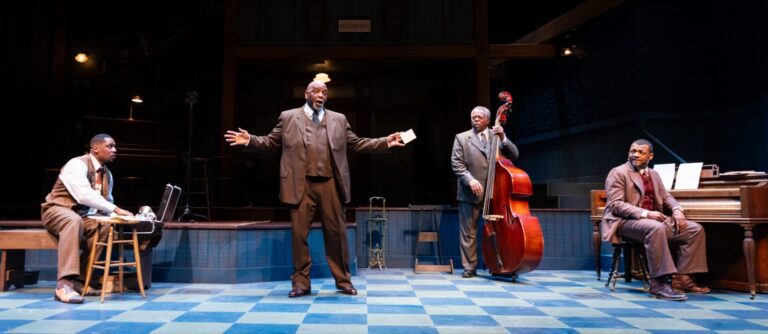
(L-R) Al’Jaleel McGhee, David Alan Anderson, Cedric Young, Kelvin Roston Jr.
GT: The Goodman is celebrating its Centennial year and during this milestone we’ve spotlighted the people who have filled our spaces for 100 years through our “Leave More Human” campaign. What are Kelvin’s words for The Goodman? / What makes being a part of The Goodman family so special?
KRJ: Goodman, continue to prove that real change and growth is possible. Keep putting your money where your mouth is. Being a part of The Goodman family is being a part of history. I can’t say enough how honored I feel in this moment.
Vicky Mejia is the Digital Marketing Associate at Goodman Theatre